
Blackstone Grill Not Getting Hot: Fix It
You fire up your Blackstone grill, crank the burners to high, and wait for that sizzle, only to find the surface barely hits 300°F. No sear, no smoke, no crisp. If your Blackstone grill is not getting hot, you are not alone. This issue affects thousands of users across every model, from the 22-inch to the 36-inch griddle.
The good news? It is almost never a broken grill. In over 90% of cases, the culprit is a tripped propane regulator safety valve, a built-in feature designed to prevent gas leaks. When triggered, it restricts flow and starves your burners of fuel. The fix is a simple reset, and if that does not work, clogs or leaks could be to blame.
This guide walks you through the exact steps to diagnose and fix a Blackstone grill not getting hot, fast. You will learn how to reset the regulator, clear blockages, avoid common mistakes, and prevent future issues.
Reset the Propane Regulator (Primary Fix)
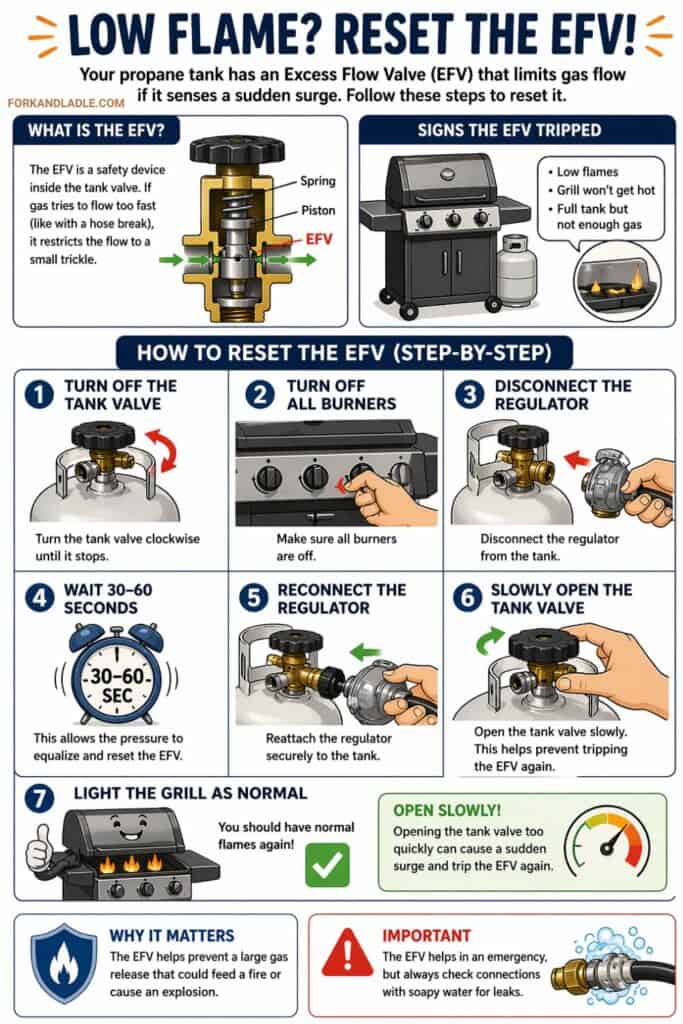
If all burners are weak and the griddle will not exceed 300°F, the regulator’s safety valve is likely tripped. This happens when gas pressure surges, such as when you open the tank too fast. Here is how to fix it.
Why the Regulator Trips
Modern propane regulators contain a flow-limiting safety device that activates when it detects sudden pressure changes. It interprets rapid valve opening as a possible hose rupture and shuts down to prevent a leak. Once triggered, gas flow drops to a trickle, enough to light the burners but not enough to generate high heat.
Common triggers include:
– Opening the tank valve too quickly
– Turning on burners before opening the tank
– Leaving the tank valve open after cooking
– Swapping tanks without depressurizing
The result is low, flickering flames and a cold griddle, even with all knobs set to high.
Quick Reset: 1-Minute Fix
Use this method if the issue started after refilling or reconnecting the tank.
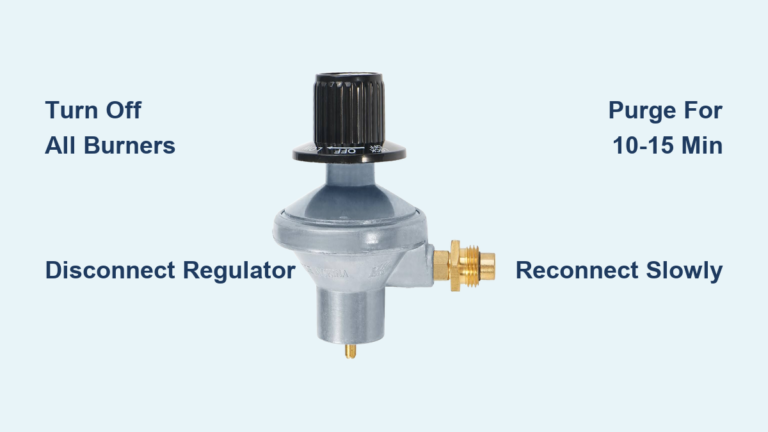
- Turn off all burners completely.
- Close the propane tank valve (clockwise until tight).
- Disconnect the regulator from the tank.
- Wait 30 to 60 seconds to let internal pressure reset.
- Reconnect the regulator firmly (hand-tight only).
- Open the tank valve slowly:
– Turn just a crack (1/4 turn), wait 30 seconds.
– Turn another quarter, wait 30 seconds.
– Repeat until fully open (aim for 1 turn per second). - Turn on burners and ignite.
Success sign: Strong, steady blue flames across all burners.
Pro Tip: Never “crank” the tank valve open. Speed is the number one cause of tripped regulators.
Extended Reset: 15-Minute Fix for Stubborn Cases
If the quick reset fails, especially after leaving the tank open overnight, use this deeper reset to clear vacuum lock.
- Turn off tank valve.
- Disconnect regulator.
- Turn all burner knobs to “ON” (even though gas is off).
- Wait 15 minutes. This fully releases internal pressure and resets the safety valve.
- Turn all burners back to “OFF.”
- Reconnect regulator.
- Open tank valve slowly (as above).
- Ignite burners.
If the issue persists, repeating the 15-minute cycle is recommended for full recovery.
Expert Note: The 15-minute wait allows the internal check ball in the regulator to fully disengage from the safety position.
The “Bang” Method: Mechanical Reset (Last Resort)
Some users report success with this physical technique to dislodge the safety mechanism inside the tank valve.
- Turn off tank and disconnect hose.
- Firmly bang the bottom of the propane tank on concrete or asphalt (2 to 3 times).
- Reconnect hose.
- Open valve very slowly.
- Ignite.
⚠️ Caution: Only do this with a stable, upright tank. Never strike the valve or hose.
Clear Burner Blockages (Secondary Fixes)

If resetting the regulator does not help, the issue may be physical, such as spider webs, grease, or debris blocking gas flow.
Check for Spider Webs
Spiders are attracted to the smell of propane and often build nests inside burner tubes, especially after storage.
Symptoms:
– Uneven flames
– Burners that go out intermittently
– Low heat on one side
Fix:
1. Remove the griddle top and burner covers.
2. Inspect tubes for webbing or debris.
3. Use a pipe cleaner, wire brush, or compressed air to clear blockages.
4. Reassemble and test.
Prevention: Cover your grill when not in use. Consider a spider block venturi cap ($10 to $15) to seal burner tube openings.
Clean Clogged Burner Ports
Grease and food particles can clog individual ports, causing yellow flames or weak output.
Symptoms:
– Orange or yellow flames
– Spitting or popping sounds
– Sections of the burner not lighting
Steps:
1. Turn off gas and let griddle cool.
2. Remove burners and scrub ports with a small wire or toothbrush.
3. Soak in warm, soapy water if greasy.
4. Rinse and dry completely before reassembly.
Never use a toothpick or bamboo skewer. They can leave residue or break off inside the port.
Inspect Hose for Kinks and Leaks
A damaged or kinked hose restricts gas flow.
Check:
– Entire hose length for cracks, bends, or wear.
– Connections at both ends (tank and griddle) for tightness.
Leak Test:
1. Mix soapy water (dish soap + water).
2. Apply to hose, regulator, and connections.
3. Open tank valve (do not ignite).
4. Bubbles = leak.
🚨 If you see bubbles:
– Turn off tank immediately.
– Replace hose or regulator.
– Do not use until fixed.
Safety First: Always perform a leak test after reconnecting the tank.
Prevent Future Low-Heat Issues
Once you have fixed the problem, avoid repeating it with proper usage habits.
Correct Startup Sequence
Follow this order every time:
- Burners OFF (all knobs in off position).
- Connect regulator to tank.
- Open tank valve SLOWLY (1 turn per second).
- Turn on burners and ignite.
🔁 Mnemonic: “Knobs off, connect, slow open, then light.”
Proper Shutdown Sequence
- Turn off all burners.
- Close tank valve.
- Let flames die out (burn off residual gas).
- Confirm tank is closed.
Never skip closing the tank valve. Leaving it open can create a vacuum lock that trips the regulator.
Use Full 20 lb Tanks (Not Exchanges)
Tank exchange programs often refill only ~15 lbs of propane. That is 25% less fuel.
Better option: Refill at:
– Tractor Supply
– U-Haul
– Farm co-ops
– Truck stops
You will pay less and get a full 20 lbs, reducing pressure fluctuations.
Diagnose the Problem: Quick Symptom Guide

Use this guide to identify the likely cause before you start troubleshooting:
| Symptom | Likely Cause |
|---|---|
| All burners weak, max 300°F | Tripped regulator |
| One burner has yellow flame | Clogged port or spider web |
| Flames flicker or go out | Blockage or leak |
| No gas at all | Empty tank, closed valve, or kinked hose |
If all burners are affected equally, reset the regulator first. It is almost always the culprit.
When to Replace Parts

If resets and cleaning do not work, the regulator or hose may be faulty.
Replace the Regulator
- Signs: Repeated tripping, no flow after reset, visible damage.
- Solution: Buy a Blackstone OEM regulator or a high-flow universal replacement (ensure it matches input/output pressure specs).
- Cost: $25 to $40.
Note: Aftermarket regulators without safety valves exist but are not recommended. They bypass a critical safety feature.
Check for Internal Valve Issues
Rarely, the problem is inside the griddle’s gas manifold or valves. Signs include:
– Only one burner works
– No gas to specific zones
– Clicking but no ignition
🔧 Action: Contact Blackstone support or a certified technician. Do not disassemble internal gas components yourself.
Flame and Temperature Benchmarks
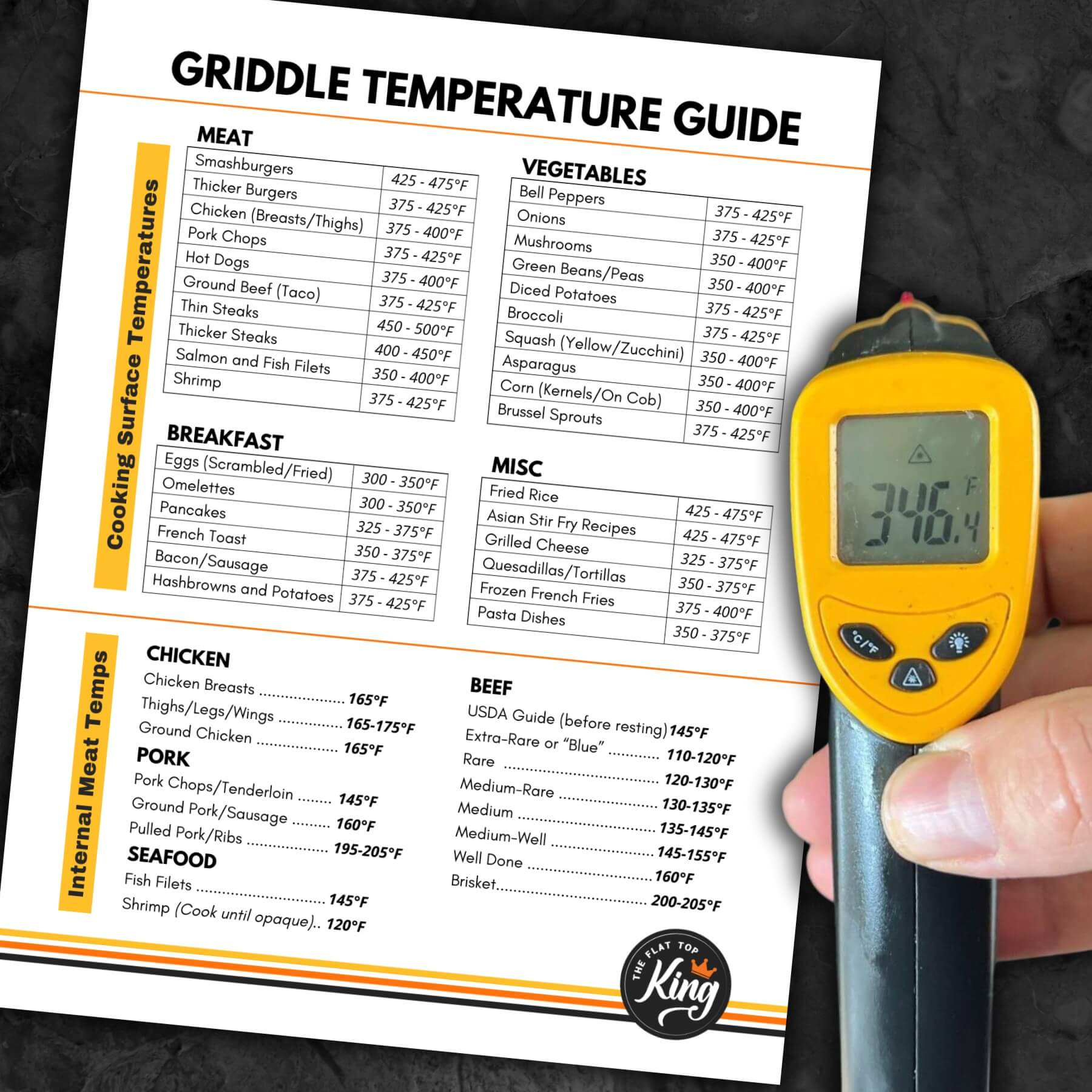
Know what healthy performance looks like:
| Condition | Flame Color | Max Temp | Notes |
|---|---|---|---|
| Normal | Steady blue | 500 to 600°F | Ready for searing |
| Restricted | Weak, flickering | <315°F | Regulator tripped |
| Clogged | Yellow/orange | Uneven heat | Clean burners |
Use an infrared thermometer to verify surface temps. Do not rely on the built-in dial, as it is often inaccurate.
Frequently Asked Questions About Blackstone Grills Not Getting Hot
Why is my Blackstone grill not getting hot even though the burners are on?
A tripped propane regulator safety valve is the most common cause. This safety feature restricts gas flow when it detects a pressure surge, such as opening the tank valve too quickly. A simple reset (disconnect, wait 30 seconds to 15 minutes, reconnect, and open slowly) usually restores full heat.
How do I reset the regulator on my Blackstone grill?
Turn off all burners and the tank valve, then disconnect the regulator. Wait 30 seconds for a quick reset or 15 minutes for stubborn cases. Reconnect the regulator, open the tank valve very slowly (about 1 turn per second), then ignite the burners. This releases the safety lock and restores full gas flow.
What temperature should a Blackstone griddle reach?
A properly functioning Blackstone griddle should reach 500 to 600°F on high. If your griddle will not exceed 300 to 315°F even after 10 to 20 minutes of preheating, the regulator is likely tripped or the burners are clogged.
Can spider webs cause a Blackstone griddle to lose heat?
Yes. Spiders are attracted to propane and often build nests inside burner tubes, especially after storage. This causes uneven flames, low heat, or burners that go out intermittently. Use a wire brush, pipe cleaner, or compressed air to clear the blockages.
Should I open my propane tank valve all the way?
Open it slowly rather than cranking it open. Aim for about 1 turn per second. Opening too quickly causes a pressure surge that trips the regulator’s safety valve, which is the leading cause of low-heat issues on Blackstone griddles.
When should I replace my Blackstone regulator?
Replace the regulator if it repeatedly trips after resets, shows visible damage, or fails to deliver gas flow even after a proper reset procedure. A Blackstone OEM regulator or compatible high-flow replacement costs $25 to $40 and is a reliable fix.
Final Thoughts on Fixing a Blackstone Grill Not Getting Hot
A Blackstone grill not getting hot is one of the most common and most fixable issues. Most users assume their griddle is broken, only to discover that a 1-minute reset solves everything.
Key takeaways:
– Slow valve opening prevents 90% of low-heat issues.
– Reset the regulator before buying replacement parts.
– Clean burners regularly to avoid spider web and grease clogs.
– Always test for leaks with soapy water after reconnecting the tank.
Follow these steps and your Blackstone will fire up hot, fast, and ready to sear every single time. Start with the quick regulator reset now, and you will likely be cooking within five minutes.